Key Takeaways
- Norovirus symptoms usually last 1 to 3 days in otherwise healthy adults
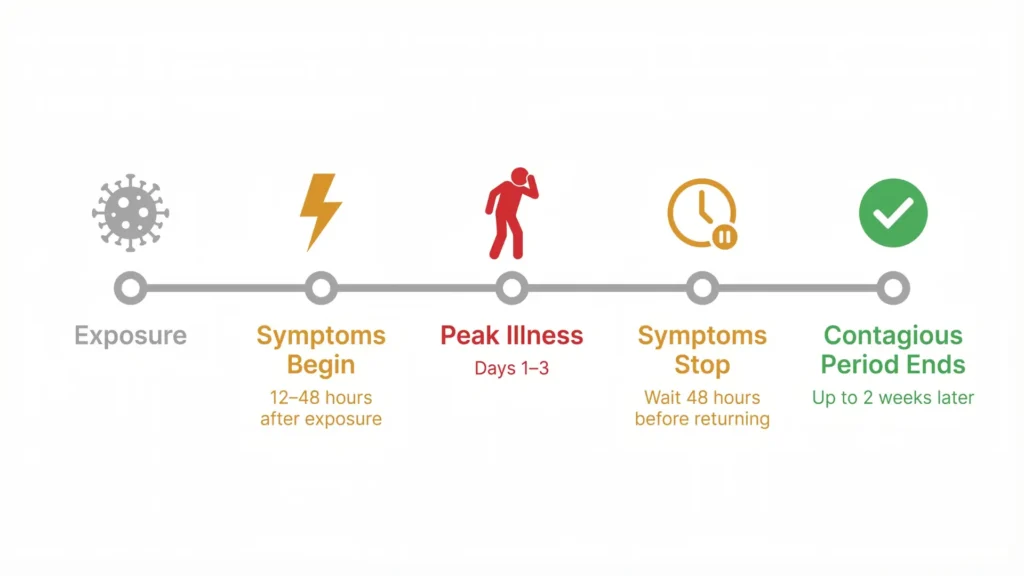
- Symptoms typically begin 12 to 48 hours after exposure
- You can remain contagious for up to two weeks after symptoms stop - even when you feel completely fine
- Standard alcohol-based hand sanitizer is not reliably effective against norovirus
- Wash your hands with soap and water for at least 20 seconds — it's still the single most effective prevention measure
- Hypochlorous acid (HOCl) is an EPA-recognized disinfectant that kills norovirus on surfaces without the harshness of bleach
What Is Norovirus — And Why Does It Spread So Easily?
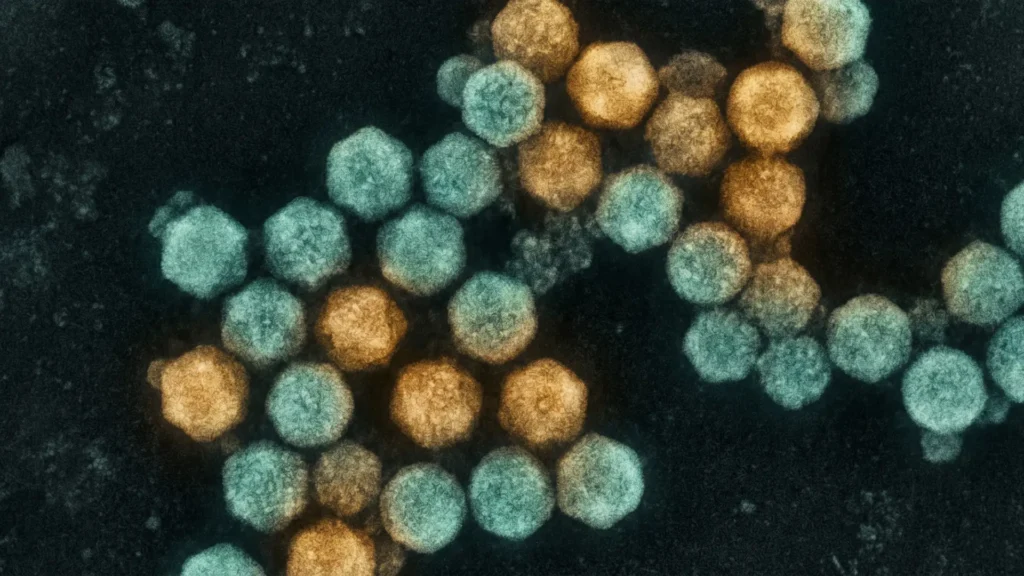
Norovirus is a highly contagious virus that causes sudden inflammation of the stomach and intestines – what doctors call gastroenteritis (stomach and gut infection). You’ve probably heard it called the “stomach flu,” though norovirus is not related to the flu (influenza) at all. They’re entirely different viruses.
According to the Centers for Disease Control and Prevention (CDC), norovirus is the leading cause of foodborne illness in the United States, triggering an estimated 19–21 million cases of vomiting and diarrhea every year. It’s also responsible for the majority of gastroenteritis outbreaks in closed settings – cruise ships, nursing homes, hospitals, restaurants, and child care centers.
The reason norovirus spreads so efficiently? It takes very few viral particles to get someone sick. We’re talking fewer than 20 particles to cause infection. That’s a microscopic amount.
According to the Centers for Disease Control and Prevention (CDC), norovirus is the leading cause of foodborne illness in the United States, triggering an estimated 19–21 million cases of vomiting and diarrhea every year. It’s also responsible for the majority of gastroenteritis outbreaks in closed settings – cruise ships, nursing homes, hospitals, restaurants, and child care centers.
The reason norovirus spreads so efficiently? It takes very few viral particles to get someone sick. We’re talking fewer than 20 particles to cause infection. That’s a microscopic amount.
How Long Do Norovirus Symptoms Last?
Most people want a straight answer — so here it is.
Norovirus symptoms usually last 1 to 3 days. For healthy adults, that’s the typical window. Symptoms usually begin 12 to 48 hours after exposure, hit hard and fast, then resolve on their own within a few days.
That said, the duration of norovirus illness can stretch longer in:
Norovirus symptoms usually last 1 to 3 days. For healthy adults, that’s the typical window. Symptoms usually begin 12 to 48 hours after exposure, hit hard and fast, then resolve on their own within a few days.
That said, the duration of norovirus illness can stretch longer in:
- Older adults — more vulnerable to complications like dehydration
- Young children — can deteriorate quickly if fluids aren’t replaced
What Are the Symptoms of Norovirus?
The symptoms of norovirus infection usually come on suddenly — often within hours of exposure. There’s rarely a slow build-up.
Classic signs and symptoms include:
- Vomiting — often forceful and repeated
- Diarrhea — watery, non-bloody
- Nausea
- Stomach cramps
- Low-grade fever, headaches, and body aches in some cases
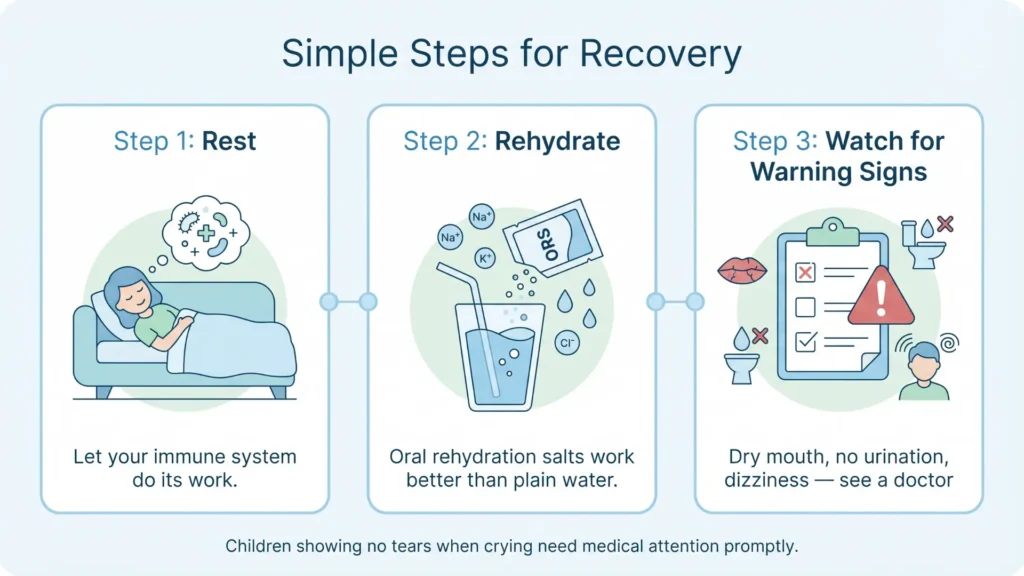
Symptoms of dehydration include dry mouth:
- Dry mouth
- Extreme thirst
- Less Urination
- Dizziness
How Long Are You Contagious With Norovirus?
This is probably the most important part of this article — and the part most people get wrong.
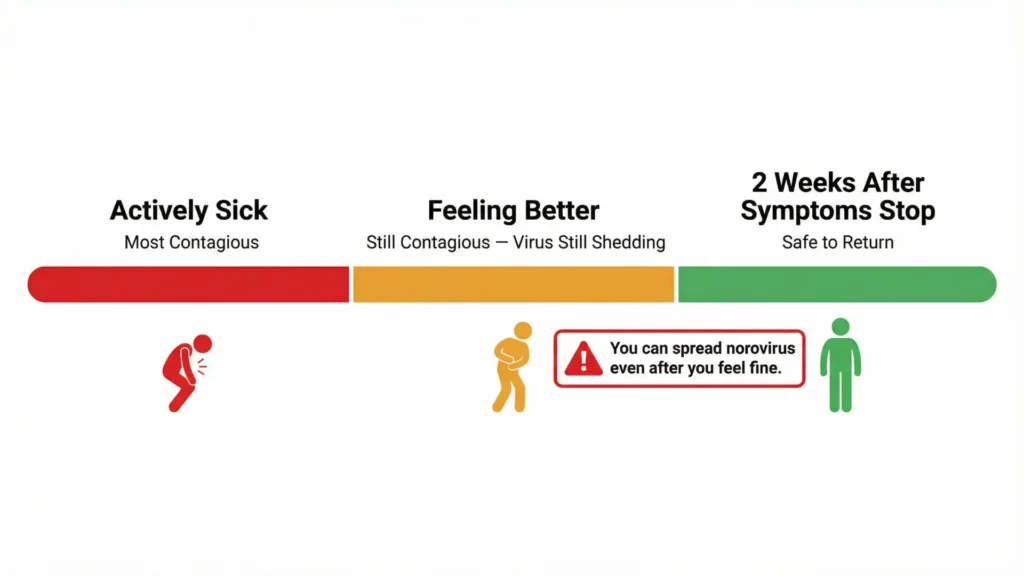
A person is most contagious while actively vomiting or experiencing diarrhea. That much is expected. But norovirus can shed (leave the body) for at least two weeks after symptoms stop — which means you can still be contagious for two weeks after you feel completely normal.
A person is most contagious while actively vomiting or experiencing diarrhea. That much is expected. But norovirus can shed (leave the body) for at least two weeks after symptoms stop — which means you can still be contagious for two weeks after you feel completely normal.
The CDC recommends not returning to work, school, or food preparation until at least 48 hours after symptoms have stopped.
But given the extended shedding window, strict hand hygiene should continue well beyond that.
This prolonged contagious period is a big part of why norovirus outbreaks in nursing homes, cruise ships, and hospitals are so difficult to contain once they start.
This prolonged contagious period is a big part of why norovirus outbreaks in nursing homes, cruise ships, and hospitals are so difficult to contain once they start.

How Does Norovirus Spread?
Norovirus spreads through contaminated food, water, surfaces, and direct contact with an infected person. The technical term is fecal-oral transmission —i.e. traces of feces from someone with norovirus make their way (invisibly) into another person’s mouth.(Gross, we know.)
In practice, that happens through:
In practice, that happens through:
- Touching a contaminated door handle, countertop, toilet, or shared surface — then touching your mouth
- Eating food prepared by someone infected with norovirus
- Drinking contaminated water
- Sharing towels, utensils, or clothing with an infected person
- Being near someone who vomits — because norovirus can briefly travel via respiratory droplets in that moment
How Long Does Norovirus Survive on Surfaces and Food?
Norovirus can survive on surfaces for days. Some research suggests it can persist even longer on hard surfaces like countertops, door handles, and bathroom fixtures under the right conditions.
It’s also remarkably tough !
t can survive freezing temperatures, which means contaminated food that’s been frozen is not necessarily safe.Shellfish like oysters are a well-documented source of norovirus outbreaks because they filter and concentrate the virus from contaminated water.
What this means practically: wiping a surface with a standard household cleaner or spraying hand sanitizer isn’t enough. Most alcohol-based hand sanitizers show limited effectiveness against norovirus. You need a disinfectant that’s been verified to eliminate norovirus — and you need to use it consistently on high-touch areas.
It’s also remarkably tough !
t can survive freezing temperatures, which means contaminated food that’s been frozen is not necessarily safe.Shellfish like oysters are a well-documented source of norovirus outbreaks because they filter and concentrate the virus from contaminated water.
What this means practically: wiping a surface with a standard household cleaner or spraying hand sanitizer isn’t enough. Most alcohol-based hand sanitizers show limited effectiveness against norovirus. You need a disinfectant that’s been verified to eliminate norovirus — and you need to use it consistently on high-touch areas.
How to Treat Norovirus?
There is no specific treatment for norovirus. Antibiotics don’t work on viruses, and no antiviral drug currently exists to treat norovirus illness directly.
Treatment is entirely supportive:
- Stay hydrated — replace fluids lost through vomiting and diarrhea
- Oral rehydration solutions(like electrolyte drinks) are more effective than plain water, especially for children
- Rest — your immune system is doing the work; let it
- Avoid preparing food for others until at least 48 hours after symptoms stop
How to Kill Norovirus ?
Preventing norovirus comes down to two things: hand hygiene and surface disinfection.Wash your hands with soap and water for at least 20 seconds — after using the bathroom, after changing diapers, and before you prepare food. This is non-negotiable.Hand sanitizer alone is not reliably effective against norovirus, which is why soap and water remains the recommendation from the CDC and public health authorities worldwide.
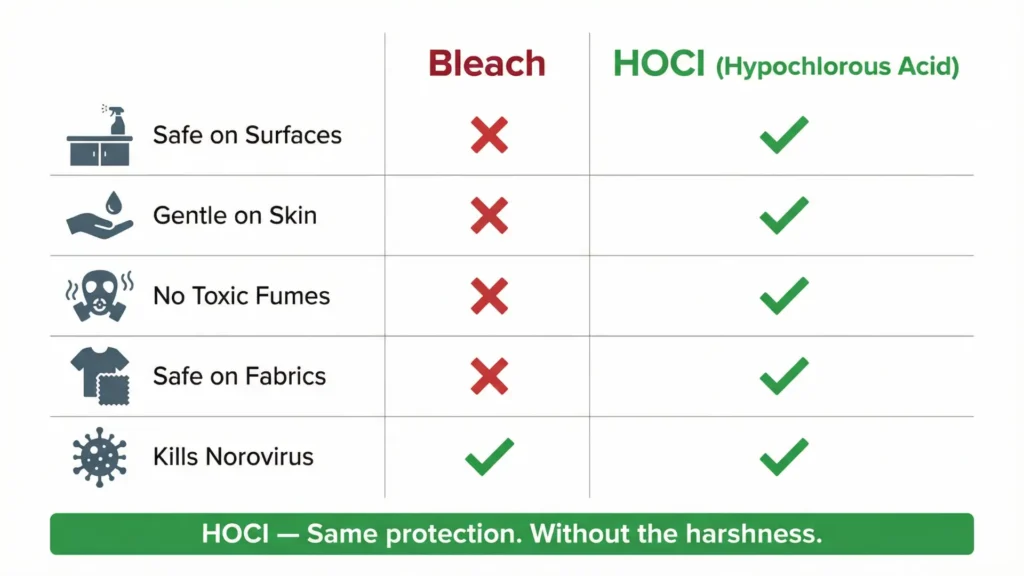
For surfaces, the CDC points to disinfectants with demonstrated efficacy against norovirus. Bleach solutions are the traditional go-to — but bleach is corrosive to surfaces, harsh on skin, damaging to fabrics, and produces fumes that are genuinely unpleasant and potentially harmful in enclosed spaces.
Hypochlorous acid (HOCl) is a practical, science-backed alternative worth knowing about.
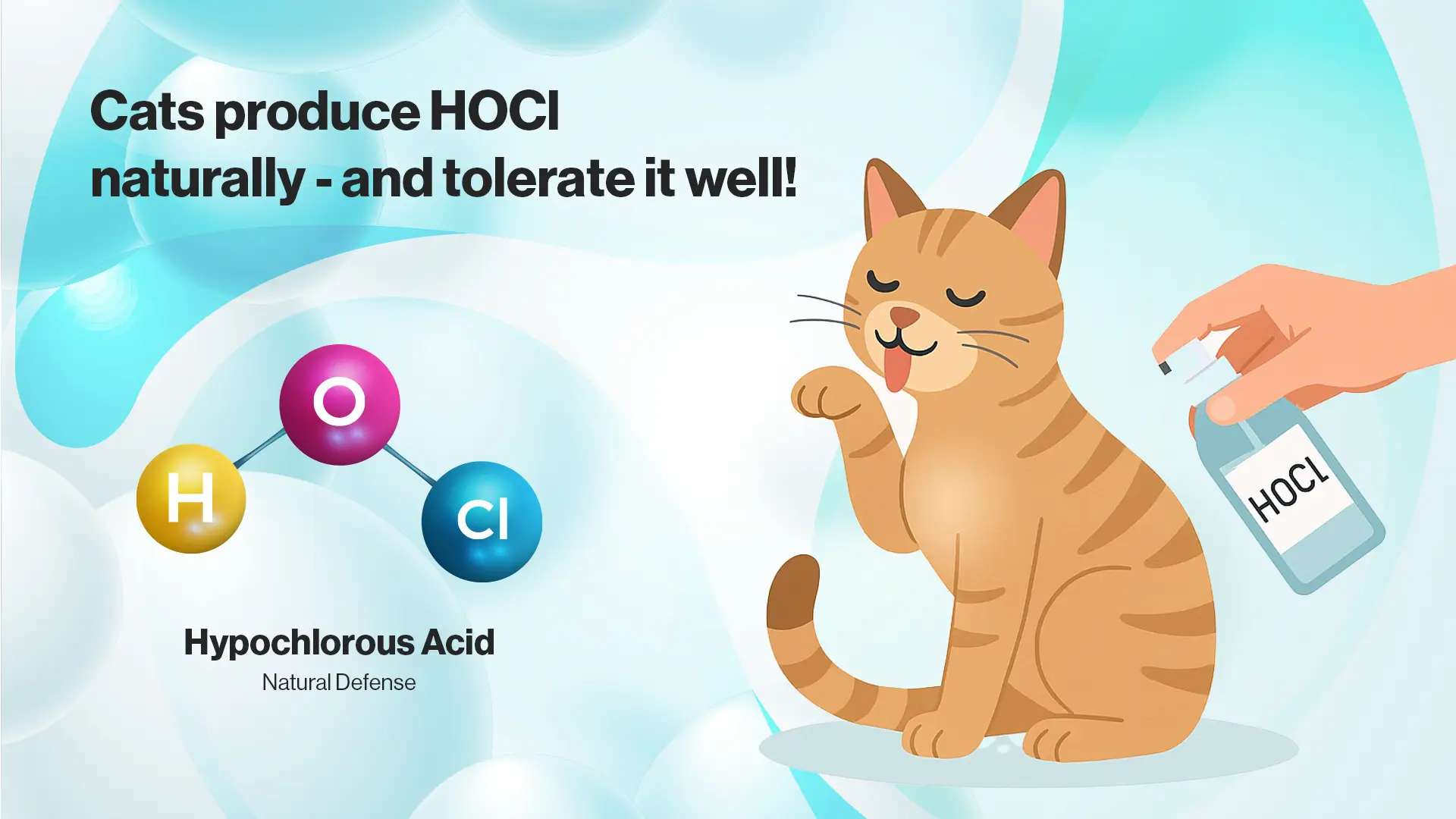
HOCl is an EPA-approved disinfectant effective against a broad spectrum of pathogens — including those in the norovirus category. What makes it interesting is its origin: it’s the same molecule your white blood cells produce naturally to fight off infection. That’s why it’s non-toxic, non-irritating, and safe around children, pets, and people with respiratory sensitivities.Unlike bleach, HOCl:
You can read more about how hypochlorous acid compares to bleach and explore HOCl-based disinfectant products built for exactly this kind of everyday protection. For larger facilities like — nursing homes, hospitals and child care centres — bulk HOCl solutions are available for wider-scale disinfection. If you want to understand how HOCl actually works against viruses, that’s worth a read too.
For surfaces, the CDC points to disinfectants with demonstrated efficacy against norovirus. Bleach solutions are the traditional go-to — but bleach is corrosive to surfaces, harsh on skin, damaging to fabrics, and produces fumes that are genuinely unpleasant and potentially harmful in enclosed spaces.
Hypochlorous acid (HOCl) is a practical, science-backed alternative worth knowing about.
HOCl is an EPA-approved disinfectant effective against a broad spectrum of pathogens — including those in the norovirus category. What makes it interesting is its origin: it’s the same molecule your white blood cells produce naturally to fight off infection. That’s why it’s non-toxic, non-irritating, and safe around children, pets, and people with respiratory sensitivities.Unlike bleach, HOCl:
- Won’t damage countertops, electronics, or fabrics
- Is safe if accidentally contacted with skin or eyes
- Leaves no harmful chemical residues on surfaces
- Can be used consistently — daily, if needed — without the usual concerns around chemical exposure
- door handles,
- bathroom fixtures,
- toilet seats,
- kitchen countertops
You can read more about how hypochlorous acid compares to bleach and explore HOCl-based disinfectant products built for exactly this kind of everyday protection. For larger facilities like — nursing homes, hospitals and child care centres — bulk HOCl solutions are available for wider-scale disinfection. If you want to understand how HOCl actually works against viruses, that’s worth a read too.
Frequently Asked Questions
You’re most contagious during active symptoms, but you may still be contagious for up to two weeks after symptoms stop. The virus continues shedding from the body even once you feel better.
Norovirus can survive on surfaces for days. Hard surfaces like countertops, door handles, and bathroom fixtures should be disinfected with a verified disinfectant — not just wiped down with a general cleaner.
It can persist on food even through freezing. Cooking food to the right temperature and avoiding food preparation while sick are the most reliable precautions.
Not reliably. Most alcohol-based hand sanitizers show limited effectiveness against norovirus. Soap and water for at least 20 seconds is the recommended approach.
The typical duration — 1 to 3 days — is generally the same, but dehydration is a greater risk during pregnancy. Seek medical advice if symptoms are severe or don’t improve within 48 hours.
Dogs can contract a canine form of norovirus. Symptoms typically resolve within a few days, but consult a vet if they persist or worsen.